
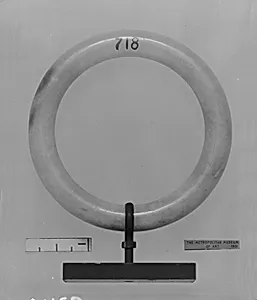
Armlet
Unknown Artist
1796–1875
Medium
Jadeite
Dimensions
H. 3 1/8 in. (8 cm); W. 7/16 in. (1.1 cm)
Classification
Jade
Culture & Period
China · Qing dynasty (1644–1911)
Department
Asian Art
Museum
Metropolitan Museum of Art, New York, NY
Credit
Gift of Heber R. Bishop, 1902
Accession Number
02.18.718
Rights
Public Domain
Art Historical Context
This delicate jadeite armlet, crafted in China during the Qing dynasty1644–1911), exemplifies the era's mastery of jade carving, a pinnacle of imperial artistry. Dating to between 1796 and1875, this slender band—measuring just 3⅛ inches (8 cm) high and ⁷⁄₁₆ inch (1.1 cm) wide—was likely worn as a bracelet or upper-arm ornament by elite women, symbolizing purity, status, and harmony in Confucian ideals. Gifted to the Metropolitan Museum of Art in 1902 by collector Heber R. Bishop, it now graces the Asian Art department. Jadeite, a vivid green variety of jade rarer and more vibrant than nephrite, was highly prized in late Qing China for its translucency and durability. Artisans employed meticulous techniques like incising and polishing to reveal the stone's natural luster, often without added decoration to honor its intrinsic beauty. Such pieces reflected the dynasty's opulent court culture, where jade jewelry signified wealth amid growing trade with the West. Visitors to the Met can marvel at this armlet's cool, tactile allure, a testament to Qing craftsmanship that bridged tradition and refinement in 19th-century China.