
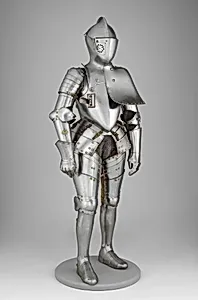
Armor for the Tilt
ca. 1580
Medium
Steel, brass, leather
Dimensions
H. 68 3/4 in. (174.6 cm); W. at shoulders 18 in. (45.72 cm); Wt. 81 lb. (36.8 kg)
Classification
Armor for Man
Culture
German, Augsburg
Department
Arms and Armor
Museum
Metropolitan Museum of Art, New York, NY
Credit
armor: Bashford Dean Memorial Collection, Gift of Helen Fahnestock Hubbard, in memory of her father, Harris C. Fahnestock, 1929; left vambrace and left gauntlet: Gift of William H. Riggs, 1913; mail brayette: Bashford Dean Memorial Collection, Funds from various donors, 1929
Accession Number
29.154.1a–u; 14.25.689h, .894; 29.158.204
Rights
Public Domain
Art Historical Context
Step into the clangor of 16th-century tournaments with *Armor for the Tilt*, around 1580 by Anton Pehauser, a master arm from Augsburg, Germany. This imposing suit, standing nearly 5 feet 9 inches tall and weighing a hefty 81 pounds, was designed specifically for the "tilt"—a dramatic jousting event where knights charged at barriers on horseback, lances shattering in displays of chivalry and prowess. Augsburg was Europe's premier armor-making hub during the Renaissance, and Peffenhauser's work exemplifies the era's blend of lethal functionality and artistic flair. Forged from steel with brass accents and leather fittings, the armor highlights advanced metallurgical techniques: precisely hammered plates for mobility, reinforced for lance impacts, and etched or gilded for visual splendor (though specifics here focus on form). The left vambrace and gauntlet, plus mail brayette, were later additions, showcasing how such pieces evolved through patronage and combat needs. Today, this treasure from the Metropolitan Museum of Art's Bashford Dean Memorial Collection invites us to ponder the Renaissance knight—not just warrior, but a living sculpture of steel, embodying German craftsmanship at its peak. Imagine the thunder of hooves as it gleams under tournament sun!