
Armor (Gusoku)
Unknown Artist
19th century
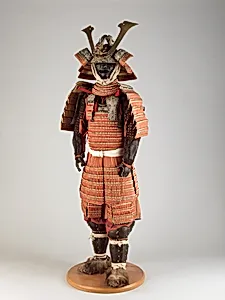
Medium
Iron, leather, lacquer, silk, copper alloy
Dimensions
as mounted, approx.: H. 77 in. (195.6 cm); W. 26 in. (66 cm); D. 16 1/2 in. (41.9 cm)
Classification
Armor for Man
Culture
Japanese
Department
Arms and Armor
Museum
Metropolitan Museum of Art, New York, NY
Credit
Rogers Fund, 1904
Accession Number
04.4.2
Rights
Public Domain
Art Historical Context
This striking 19th-century Japanesegusoku* (complete armor) stands as a testament to the samurai warrior's formidable presence, towering at nearly 77 inches tall. Crafted from iron plates laced together with silk cords, reinforced with leather, and adorned with lacquer and copper alloy fittings, it the intricate *tosei-gusoku* style developed during the Edo period. The lacquer not only provided waterproofing and corrosion resistance but also allowed for vibrant decoration, blending functionality with aesthetic elegance. Historically, such armor protected samurai during Japan's feudal era, though by the 19th century—amid the transition to the modern Meiji period—it often served ceremonial or display purposes as traditional warfare gave way to firearms and Western influences. The modular design, with hinged sections for mobility, highlights masterful metalworking techniques honed over centuries, where thousands of small plates were riveted, shaped, and polished by specialized artisans. Acquired through the Rogers Fund in 1904, this piece from the Metropolitan Museum of Art's Arms and Armor Department invites us to envision the disciplined world of the samurai, where armor was both shield and symbol of status. A closer look reveals the delicate interplay of materials, underscoring Japan's enduring fusion of art and martial tradition.