
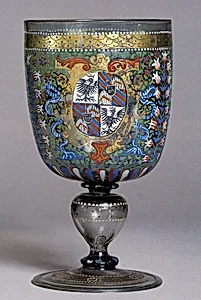
Armorial goblet
Unknown Artist
1592
Medium
Colorless (strong gray) nonlead glass. Blown, enameled, gilt.
Dimensions
H. 8 3/4 in. (22.3cm); Diam. of rim 4 7/8 in. (12.4cm)
Classification
Glass
Culture
Façon de Venise, probably southern Germany or Tyrol
Department
Robert Lehman Collection
Museum
Metropolitan Museum of Art, New York, NY
Credit
Robert Lehman Collection, 1975 1975.1.1218
Accession Number
1975.1.1218
Rights
Public Domain
Tags
Art Historical Context
This elegant armorial goblet, crafted 1592, exemplifies luxurious Façon de Venise style—a prestigious European glassmaking tradition inspired by Venice's renowned Murano workshops. Likely produced in southern Germany or Tyrol region, it stands 8¾ inches tall with a 4⅞-inch rim diameter, its colorless yet strongly gray-toned nonlead glass blown into a graceful, slender form. The surface is adorned with intricate enamel painting and gilding, featuring a prominent coat of arms that would have signified noble lineage or family prestige. Façon de Venise glass, popular across Renaissance Europe, brought Venetian sophistication to local artisans, who replicated its clarity and thin-walled elegance without lead crystal. The goblet's techniques—blowing for shape, cold enamel for vibrant colors, and gilding for opulent shine—highlight the era's technical mastery and decorative ambition. Such pieces were prized at banquets and as diplomatic gifts, blending functionality with status symbolism. Today, this goblet graces the Robert Lehman Collection at The Metropolitan Museum of Art (1975.1.1218), offering a glimpse into late 16th-century craftsmanship and the cross-cultural exchange of luxury goods that defined Europe's elite culture.