
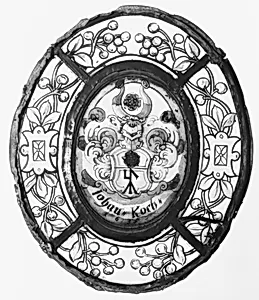
Armorial panel
Unknown Artist
1635
Medium
Stained glass
Dimensions
Overall: 9 3/4 × 8 in. (24.8 × 20.3 cm)
Classification
Glass-Stained
Culture
German
Department
European Sculpture and Decorative Arts
Museum
Metropolitan Museum of Art, New York, NY
Credit
Bequest of George D. Pratt, 1935
Accession Number
41.170.40
Rights
Public Domain
Tags
Art Historical Context
This exquisite *Armorial panel*, crafted in 1635 by an unknown German artist, is fine example of stained glass from the Baroque era's decorative arts. Measuring just 9 3/4 × 8 inches, it served as a heraldic window insert in a noble home, church, or civic building, proudly displaying a family coat of arms adorned with fruit motifs—symbols of abundance, fertility, and lineage prestige. Stained glass, made by coloring pot-metal glass with metallic oxides and assembling pieces with lead cames, was a revered medium in Europe for its luminous quality. When light passes through, the vivid hues transform the panel into a glowing emblem of identity and status. In 17th-century Germany, amid the aftermath of religious conflicts, such panels underscored continuity of noble heritage through intricate heraldry. Now in the Metropolitan Museum of Art's Department of European Sculpture and Decorative Arts, this piece entered the collection through the 1935 bequest of George D. Pratt. It invites visitors to ponder the artistry behind everyday symbols of power and pride.