
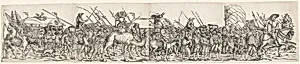
Army Train and Death
c. 1532
Medium
woodcut from four blocks, on four sheets
Dimensions
overall: 31.2 × 156.5 cm (12 5/16 × 61 5/8 in.)
Classification
Department
CG-E
Museum
National Gallery of Art, Washington, D.C.
Credit
Pepita Milmore Memorial Fund and Eugene L. and Marie-Louise Garbáty Fund
Accession Number
2017.16.1
Rights
Public Domain
Art Historical Context
Created around 1532 by the Nuremberg artist Erhard Schön, *Army Train and Death* is a monumental woodcut printed from four separate blocks on four sheets of paper. Measuring over five feet in length, the work was designed to be displayed as a single panoramic frieze. Such large-scale prints were ambitious for their time, requiring precise alignment of the blocks and demonstrating the growing technical sophistication of early sixteenth-century printmaking. The subject—an army procession accompanied by the figure of Death—reflects the turbulent era of the Reformation and frequent military conflicts in German-speaking lands. Woodcuts like this one could be produced in multiple impressions and distributed widely, allowing moral or cautionary imagery to reach broad audiences beyond the church or court. Schön’s lively line work and rhythmic arrangement of figures would have guided the viewer’s eye across the extended composition, turning the print into both an artistic spectacle and a reminder of mortality amid the pageantry of war. Today the impression is preserved in the collection of the National Gallery of Art, where its impressive scale and surviving detail continue to offer visitors a vivid glimpse into Renaissance print culture.
About the Artist
Erhard Schön · 1491–1542
He was famed as a popular printmaker, with attributions including around 1200 illustrations for 116 books and about 200 separate woodcuts. Among the best works are the woodcuts that he and Hans Springinklee made for the "Hortulus animae", published in Nuremberg in 1515 by Johannes Koberger. It was one of the most popular pre-Reformation anthologies of prayers, published in at least 20 German and L...