
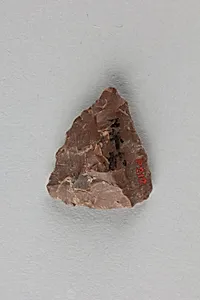
Arrowhead
Unknown Artist
Medium
Sandstone, chert or flint
Dimensions
W. 3/4 in. (1.9 cm); L. 1 in. (2.5 cm)
Classification
Stone
Culture & Period
Japan · Late Jōmon period (ca. 1500–1000 B.C.)
Department
Asian Art
Museum
Metropolitan Museum of Art, New York, NY
Credit
The Harry G. C. Packard Collection of Asian Art, Gift of Harry G. C. Packard, and Purchase, Fletcher, Rogers, Harris Brisbane Dick, and Louis V. Bell Funds, Joseph Pulitzer Bequest, and The Annenberg Fund Inc. Gift, 1975
Accession Number
1975.268.212
Rights
Public Domain
Art Historical Context
This petite arrowhead, crafted from durable sandstone, chert, or flint, hails from Japan's Late Jōmon periodca. 1500–1000 B.C.), a time when hunter-gather communities thrived across the archipelago. Measuring just 1 inch long and 3/4 inch wide, its compact form belies its practical power as a projectile point for bows or spears, essential for hunting deer, boar, and other game in dense forests and coastal regions. Jōmon artisans excelled in lithic technology, carefully knapping—chipping away at the stone—to create sharp, symmetrical edges ideal for penetration and hafting onto shafts. This technique reflects the period's ingenuity, as Jōmon people, famous for their intricate cord-marked pottery, also produced sophisticated stone tools amid a shift toward semi-sedentary villages and early experimentation with plant cultivation. As a window into prehistoric Japan, this arrowhead from The Metropolitan Museum of Art's Asian Art collection underscores the Jōmon's resourcefulness and harmony with nature, bridging daily survival with emerging cultural complexity before the Yayoi rice-farming era transformed society.