
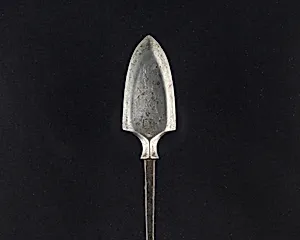
Arrowhead (<i>Yanone</i>)
Unknown Artist
18th century
Medium
Steel
Dimensions
L.10 in. (25.4 cm); L. of head 2 3/4 in. (7 cm); W. 1 1/8 in. (2.9 cm); Wt. 1.7 oz. (48.2 g)
Classification
Archery Equipment-Arrowheads
Culture
Japanese
Department
Arms and Armor
Museum
Metropolitan Museum of Art, New York, NY
Credit
The Collection of Giovanni P. Morosini, presented by his daughter Giulia, 1932
Accession Number
32.75.378
Rights
Public Domain
Art Historical Context
This exquisite steel arrowhead, known as *yanone* in Japanese, hails from 18th-century Japan, a time when the Edo period's relative peace fostered refined martial traditions like archery (*kyūdō*). Measuring just 2¾ inches long and weighing a mere 1.7 ounces, its slender, pointed form was designed for precision and penetration, ideal for warfare, hunting, or ceremonial use among samurai. Crafted from high-quality steel through masterful forging techniques, it exemplifies the Japanese smiths' legendary skill in metallurgy, balancing lethal functionality with elegant simplicity. In Japanese culture, arrowheads like this were more than mere tools—they symbolized the archer's prowess and the warrior ethos. Often customized with subtle variations in shape for armor-piercing or broad cutting, *yanone* reflect the ingenuity of arms and armor design during an era of artistic and technical innovation. This example, part of the Metropolitan Museum of Art's Arms and Armor collection, entered through the generous gift of Giovanni P. Morosini in 1932, offering visitors a tangible link to Japan's storied past. Today, it invites us to appreciate the artistry in everyday weapons, where form meets deadly purpose in harmonious balance.