
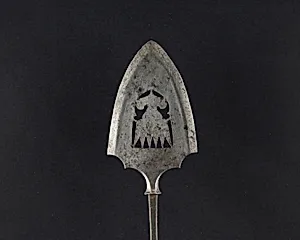
Arrowhead (<i>Yanone</i>)
Unknown Artist
18th century
Medium
Steel
Dimensions
L. 10 7/8 in. (27.7 cm); L. of head 3 3/4 in. (9.5 cm); W. 2 1/8 in. (5.4 cm); Wt. 1.7 oz. (48.2 g)
Classification
Archery Equipment-Arrowheads
Culture
Japanese
Department
Arms and Armor
Museum
Metropolitan Museum of Art, New York, NY
Credit
The Collection of Giovanni P. Morosini, presented by his daughter Giulia, 1932
Accession Number
32.75.392
Rights
Public Domain
Art Historical Context
This exquisite steel arrowhead, known as a *yanone*, hails from 18th-century Japan, a time during the Edo period when samurai culture emphasized refined martial arts amid relative peace. Measuring 10⅞ inches long overall, with a 3¾-inch head that's 2⅛ inches wide and weighing just 1.7 ounces, its slender, balanced form was engineered for precision in archery—essential for hunting, warfare, or ceremonial practice. Crafted from high-quality steel, it exemplifies the masterful Japanese metalworking techniques of the era, where forgers achieved razor-sharp edges and aerodynamic shapes through folding and tempering processes. In Japanese archery tradition, *yanone* like this one were vital tools of the warrior class, symbolizing both lethality and artistry. While warfare had waned, archery remained a disciplined pursuit, fostering focus and elegance. This piece, classified as archery equipment in the Arms and Armor department, highlights how everyday arms doubled as sculptural feats, blending utility with aesthetic harmony. Acquired through the Collection of Giovanni P. Morosini and presented to the Metropolitan Museum of Art in 1932 by his daughter Giulia, this *yanone* invites visitors to ponder the delicate interplay of beauty and power in Japanese material culture.