
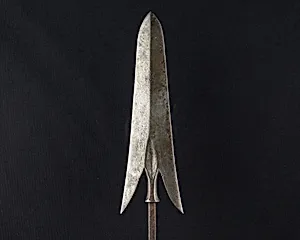
Arrowhead (<i>Yanone</i>)
Unknown Artist
18th century
Medium
Steel
Dimensions
L. 15 7/8 in. (40.4 cm); L. of head 6 1/4 in. (15.9 cm); W. 1 7/8 in. (4.8 cm); Wt. 4.8 oz. (136.1 g)
Classification
Archery Equipment-Arrowheads
Culture
Japanese
Department
Arms and Armor
Museum
Metropolitan Museum of Art, New York, NY
Credit
The Collection of Giovanni P. Morosini, presented by his daughter Giulia, 1932
Accession Number
32.75.453
Rights
Public Domain
Art Historical Context
This exquisite steel arrowhead, known as *yanone*, hails from 18th-century Japan, a time when the Edo period's samurai culture emphasized precision craftsmanship in arms and armor. Measuring 15⅞ inches overall with a 6¼-inch head, 1⅞ inches wide, and weighing just 4.8 ounces, its balanced proportions reflect masterful forging techniques. Japanese smiths tempered high-carbon steel to achieve exceptional sharpness and durability, blending utilitarian function with aesthetic refinement typical of the era's metalwork. In Japanese warfare and archery traditions, *yanone* like this were essential for bows (*yumi*), used in both battle and ceremonial *kyūdō*. Varied head shapes pierced armor or hunted game, showcasing the culture's reverence for the bow as a symbol of honor and skill—predating firearms in samurai lore. Though the artist remains unknown, such pieces highlight the anonymous genius of Edo-period artisans, whose work rivaled sword-making in intricacy. Acquired through Giovanni P. Morosini's renowned collection and gifted to the Metropolitan Museum of Art in 1932, this *yanone* invites visitors to appreciate how everyday weapons embodied Japan's artistic ethos of beauty in lethality. A testament to enduring craftsmanship!