
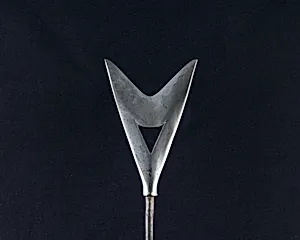
Arrowhead (<i>Yanone</i>)
Unknown Artist
18th century
Medium
Steel
Dimensions
L. 8 5/8 in. (21.8 cm); L. of head 3 1/4 in. (8.3 cm); W. 2 1/8 in. (5.4 cm); Wt. 1.5 oz. (42.5 g)
Classification
Archery Equipment-Arrowheads
Culture
Japanese
Department
Arms and Armor
Museum
Metropolitan Museum of Art, New York, NY
Credit
The Collection of Giovanni P. Morosini, presented by his daughter Giulia, 1932
Accession Number
32.75.502
Rights
Public Domain
Art Historical Context
This exquisite steel arrowhead, known as *yanone* in Japanese, hails from 18th-century Japan during the Edo period—a time of relative peace under the Tokugawa shogunate, yet one where martial traditions like archery remained central to samurai culture. Measuring 8⅝ inches long with a 3¼-inch head, this lightweight (1.5 oz.) piece exemplifies the precision craftsmanship of Japanese arms makers. Forged from high-quality steel, *yanone* were designed for kyūdō (Japanese archery), a discipline blending combat utility, Zen philosophy, and aesthetic refinement. The broad, barbed head (2⅛ inches wide) suggests it was optimized for hunting or penetrating armor, reflecting advanced metallurgical techniques like folding and differential hardening that produced razor-sharp edges resilient to impact. Though the artist is unknown, such arrowheads were often produced by specialized smiths whose work elevated functional weapons to art objects, admired for their balance and form. Acquired through the Giovanni P. Morosini Collection and gifted to the Metropolitan Museum of Art in 1932, this *yanone* offers a glimpse into Japan's enduring warrior ethos. Visitors can appreciate how even a small tool carried profound cultural weight, symbolizing discipline and harmony in motion.