
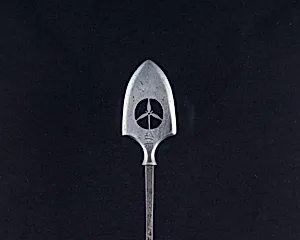
Arrowhead (<i>Yanone</i>)
Unknown Artist
18th century
Medium
Steel
Dimensions
L. 7 3/4 in. (19.7 cm); L. of head 2 1/4 in. (5.7 cm); W. 1 1/8 in. (2.9 cm); Wt. 0.9 oz. (25.5 g)
Classification
Archery Equipment-Arrowheads
Culture
Japanese
Department
Arms and Armor
Museum
Metropolitan Museum of Art, New York, NY
Credit
The Collection of Giovanni P. Morosini, presented by his daughter Giulia, 1932
Accession Number
32.75.655
Rights
Public Domain
Art Historical Context
This exquisite **Yanone** arrowhead, crafted in 18th-century Japan from finely forged steel, exemplifies the precision engineering of Edo-period archery equipment. Measuring just 7¾ inches long overall, with a 2¼-inch head that's 1⅛ inches wide and weighing a mere 0.9 ounces, its slender, aerodynamic form was designed for deadly accuracy in flight. Displayed in the Metropolitan Museum of Art's Arms and Armor Department, it reflects the technical mastery of Japanese blacksmiths, who tempered steel to balance strength, lightness, and penetration. In Japanese culture, archery—known as *kyūdō*—held profound martial and ceremonial significance, rooted in samurai traditions even during the relatively peaceful Edo era (1603–1868). Yanone arrowheads like this one varied in design for hunting, warfare, or ritual, underscoring their dual role as functional tools and symbols of discipline and skill. The steel medium highlights advanced metallurgical techniques, where repeated folding and hammering produced resilient edges capable of piercing armor. Acquired through the Collection of Giovanni P. Morosini and presented by his daughter Giulia in 1932, this artifact invites us to appreciate the artistry in everyday weaponry, bridging utility and elegance in Japanese craftsmanship.