
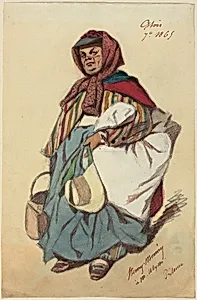
Artois
Medium
pen and red ink and watercolor over graphite
Dimensions
overall (approximate): 24.5 x 16.1 cm (9 5/8 x 6 5/16 in.)
Classification
Drawing
Department
CG-E
Museum
National Gallery of Art, Washington, D.C.
Credit
Rosenwald Collection
Accession Number
1943.3.6250
Rights
Public Domain
Art Historical Context
Henry Bonaventure Monnier's *Artois* (1869) captures the essence of 19th-century French draftsmanship through its delicate mixed-media technique. Created with pen and red ink, watercolor, and graphite underdrawing on a modest sheet measuring about 24.5 x 16.1 cm, this work exemplifies the intimate scale favored by artists for studies or finished compositions. The red ink—often called sanguine—lends a warm, earthy glow, while the graphite foundation allows precise shading, blending line and color in a fluid, spontaneous manner typical of the era's sketchbooks. Monnier (1799–1877), a prominent French caricaturist and illustrator, bridged Romanticism and emerging Realism with his sharp observations of society. Though best known for satirical figures like the bourgeois Joseph Prudhomme, *Artois* reflects his skill in landscape depiction, evoking the historic northern French province amid the waning Second Empire. This period saw rapid industrialization transforming rural scenes, making such drawings poignant records of vanishing traditions. Housed in the National Gallery of Art's Rosenwald Collection, *Artois* highlights the collector's passion for masterful drawings. Its techniques showcase how 19th-century artists innovated with accessible materials, producing works as vivid and enduring as oil paintings—perfect for savoring the interplay of light, texture, and place.