
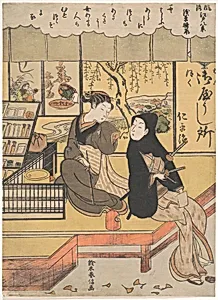
風俗江戸八景 浅草晴嵐|Asakusa Seiran
Medium
Woodblock print; ink and color on paper
Dimensions
H. 10 3/4 in. (27.3 cm); W. 7 13/16 in. (19.8 cm)
Classification
Prints
Culture & Period
Japan · Edo period (1615–1868)
Department
Asian Art
Museum
Metropolitan Museum of Art, New York, NY
Credit
H. O. Havemeyer Collection, Bequest of Mrs. H. O. Havemeyer, 1929
Accession Number
JP1648
Rights
Public Domain
Tags
Art Historical Context
Suzuki Harunobu's *Asakusa Seiran* (Asakusa Clear Storm), part of the series *Fūzoku Edo Hachikei* (Customs of Edo's Views), captures the vibrant urban life of Edo-period Japan (1615–1868). Created as a woodblock print with and color on paper, this intimate work measures just 10¾ × 7⅞ inches, designed for affordable enjoyment by the growing merchant class. Harunobu a pioneering ukiyo-e artist in the mid-18th century, revolutionized printmaking by perfecting *nishiki-e* (brocade pictures)—full-color woodblocks layered with delicate pigments for lifelike depth and luminosity. The scene evokes the bustling Asakusa district, famed for its Senso-ji Temple and lively atmosphere. Amid tags suggesting swords, pipes, men, and women, it likely depicts everyday revelry: samurai with blades, smokers puffing long pipes (*kiseru*), and mingling figures under clearing skies post-storm. This reflects ukiyo-e's "floating world" ethos, celebrating fleeting pleasures amid Japan's rigid social hierarchy. Housed in the Metropolitan Museum of Art's H. O. Havemeyer Collection, this print highlights Harunobu's mastery of subtle gradients and expressive poses, influencing later masters like Hiroshige. It offers a window into Edo's cultural pulse, where art democratized beauty for all.
About the Artist
Suzuki Harunobu · 1725–1770
Suzuki Harunobu (c. 1725-1770) was a Japanese ukiyo-e artist who revolutionized woodblock printing by developing nishiki-e—full-color prints using multiple woodblocks—in 1765. Before Harunobu, Japanese prints were limited to two or three colors; his innovation unleashed the entire artist's palette, transforming ukiyo-e into the vibrant art form that would later captivate Western artists from Manet...