
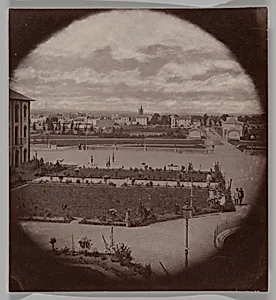
Asile impériale de Vincennes, vue de Charenton
Charles Nègre, 1858–59
About this artwork
**Asile impériale Vincennes, vue de Char** (1858–59) a serene yet poignant landscape by pioneering French photographer Charles Nègre From the vantage of Charenton, it depicts the Imperial Asylum of Vincennes, a grand Second Empire institution near Paris built during Napoleon III's reign. This view reflects mid-19th-century France's blend of architectural ambition and social reform, as asylums like this symbolized progressive care for the mentally ill amid rapid urbanization. Printed as an albumen silver print from a glass negative, the work showcases Nègre's mastery of early photographic techniques. Albumen prints, using egg whites to bind light-sensitive silver salts, delivered exceptional clarity and warm tones—key to photography's rise as fine art in the 1850s. Nègre, influenced by contemporaries like Gustave Le Gray, favored large-format negatives for intricate detail, bridging documentary realism with artistic composition. Part of the Gilman Collection at The Metropolitan Museum of Art, this 7-by-6½-inch gem highlights photography's power to preserve overlooked scenes. Nègre's subtle framing invites viewers to ponder the humanity behind institutional facades, a hallmark of his poetic urban studies. A window into 19th-century innovation, it reminds us how photographs once froze time's fleeting light. (198 words)