
Assassination of Julius Caesar
1793–96
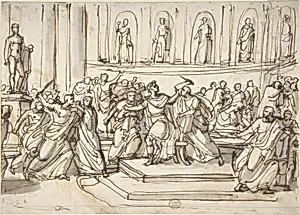
Medium
Pen and brown ink with brush and gray wash over graphite
Dimensions
Sheet: 7 9/16 × 10 9/16 in. (19.2 × 26.9 cm)
Classification
Drawings
Department
Drawings and Prints
Museum
Metropolitan Museum of Art, New York, NY
Credit
Gift of Cephas G. Thompson, 1887
Accession Number
87.12.171
Rights
Public Domain
Tags
Art Historical Context
Step into the dramatic tension of Vincenzo Camuccini's *Assassination of Julius* (1793–96), a masterful preparatory drawing that captures one of history's most infamous moments. Created during the late Enlightenment era, when fascination with ancient Rome surged amid revolutionary fervor in Europe, this work depicts the brutal stabbing of Julius Caesar on the Ides of March in 44 BC. Camuccini, an Italian artist steeped in Neoclassicism, draws viewers into the chaos through dynamic figures—senators lunging with daggers, Caesar recoiling in betrayal—evoking the timeless themes of power, ambition, and treachery immortalized by Plutarch and Shakespeare. Executed in pen and brown ink with brush and gray wash over graphite on a modest 7 9/16 × 10 9/16 in. sheet, the piece showcases virtuoso draftsmanship. The brown ink outlines fluid, expressive forms, while subtle gray washes build depth and shadow, mimicking the chiaroscuro effects of grand history paintings. This technique, common in studio sketches, allowed artists like Camuccini to refine compositions before scaling up to oil canvases, blending precision with emotional intensity. Housed in the Metropolitan Museum of Art's Drawings and Prints department since 1887, this intimate study highlights Neoclassicism's reverence for classical antiquity, inviting us to ponder Caesar's fall as a cautionary tale. A window into 18th-century artistic process, it reminds us how drawings like this fueled the era's epic narratives.
About the Artist
Vincenzo Camuccini · 1771–1844
Comment on works: Portraits; History