
Astrolabe of ‘Umar ibn Yusuf ibn ‘Umar ibn ‘Ali ibn Rasul al-Muzaffari
dated A.H. 690/ 1291 CE
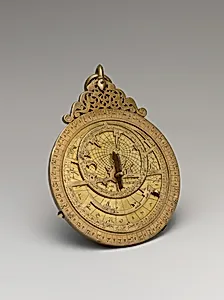
Medium
Brass; cast and hammered, pierced, chased, inlaid with silver
Dimensions
Case (a): Max. W. 7 5/8 in. (19.4 cm) Diam. 6 1/8 in. (15.6 cm) D. 1/4 in. (0.6 cm) Bar with attached nail (b): Max. H. 1 7/8 in. (4.8 cm) Max. W. 1 1/8 in. (2.9 cm) L. 5 in. (12.7 cm) Net (c): Diam. 5 in. (12.7 cm) Plates (d-g): Diam. 5 in. (12.7 cm) Pin (h): L. 1 3/4 in. (4.4 cm) W. 1/2 in. (1.3 cm)
Classification
Metal
Department
Islamic Art
Museum
Metropolitan Museum of Art, New York, NY
Credit
Edward C. Moore Collection, Bequest of Edward C. Moore, 1891
Accession Number
91.1.535a–h
Rights
Public Domain
Tags
Art Historical Context
Step into the cosmos with the *Astrolabe of ‘Umar ibn Yusuf ibn ‘Umar ibn ‘Ali ibn Rasul al-Muzaffari*, a masterful brass instrument crafted in 1291 CE (A.H. 690) during the golden age of Islamic science. Made by the named artisan, likely connected to the scholarly Rasulid dynasty in Yemen, this astrolabe exemplifies the era's seamless blend of astronomy and artistry. Portable yet precise, it served as a multifunctional tool for measuring star altitudes, determining prayer times, finding directions, and surveying land—essential for navigators, astronomers, and devout Muslims aligning life with the heavens. The astrolabe's intricate construction highlights virtuoso metalworking techniques: brass was cast and hammered into a 6-inch diameter case, then pierced for delicate openwork, chased with fine engravings, and inlaid with shimmering silver for readability and elegance. Its components—a rotatable net (rete) for stars, interchangeable latitude plates, and sighting bar—reveal sophisticated engineering, inscribed with Arabic script for scales and tables. Such opulent functionality was a hallmark of 13th-century Islamic metalwork, where scientific precision met aesthetic splendor. Housed in the Metropolitan Museum of Art's Islamic Art Department from the Edward C. Moore Collection, this astrolabe invites us to marvel at medieval ingenuity. It underscores how Islamic scholars preserved and advanced ancient Greek knowledge, influencing global science for centuries. A true treasure for any visitor pondering humanity's quest to map the stars!