
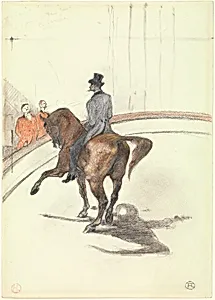
At the Circus: The Spanish Walk (Au Cirque: Le Pas espagnol)
Henri de Toulouse-Lautrec, 1899
About this artwork
Henri de Toulouse-Lautrec *At the Circus: The Walk (Au Cirque Le Pas espagnol)* created in 1899, the vibrant energy of Parisian circus life during the Belle Époque. The French Post-Impressionist artist, renowned his posters and depictions of Montmartre's bohem underbelly, was particularly drawn to the circus as a spectacle of human and animal performance. Here, he sketches a dynamic moment of equestrian dressage—the "Spanish Walk," where horses lift their front legs in a high-stepping gait—blending grace with the raw excitement of the ring. Rendered in graphite, black and colored pastel, and charcoal on heavy off-white wove paper (13 3/4 x 9 13/16 in.), this intimate drawing showcases Toulouse-Lautrec's masterful use of mixed media. His loose, expressive lines and bold pastel strokes convey movement and light, evoking the fleeting atmosphere of live performance without rigid detail. Part of the Robert Lehman Collection at The Metropolitan Museum of Art, it exemplifies his shift toward drawings in his later years, amid health struggles from alcoholism and congenital issues. This work highlights the circus's cultural allure in fin-de-siècle Paris, a democratic entertainment mirroring society's highs and lows—much like Toulouse-Lautrec's own world of cabarets and outliers. Visitors can sense the artist's empathy for performers, frozen in a joyful, precarious pas de deux between man and horse.