
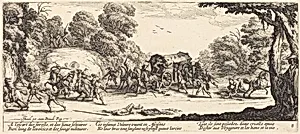
Attack on a Coach
c. 1633
Medium
etching on laid paper
Dimensions
plate: 8.3 × 18.7 cm (3 1/4 × 7 3/8 in.) sheet: 10.3 × 20.8 cm (4 1/16 × 8 3/16 in.)
Classification
Department
CG-E
Museum
National Gallery of Art, Washington, D.C.
Credit
Rosenwald Collection
Accession Number
1943.3.2221
Rights
Public Domain
Art Historical Context
**Attack on a Coach** Callot, c. 1633 Etching on laid paper,: 8.3 × 18.7 cm Step into the dramatic world of Jacques Callot's *Attack on a Coach*, masterful etching from around 1633, now housed in the National Gallery Art's Rosenwald Collection This compact print (just 3¼ × 7⅜ inches) captures a tense moment of highway robbery, with bandits ambushing a horse-drawn coach amid swirling chaos. Callot, a pioneering French Baroque printmaker (1592–1635), was renowned for his intricate etchings that brought vivid narratives to life on paper, making high art accessible through affordable reproductions. Etching on laid paper was Callot's specialty, allowing him to achieve extraordinary detail in tiny spaces—think dozens of figures in dynamic poses, rendered with fine, expressive lines using a technique he refined with multiple acid bites for depth and texture. Created during the tumultuous Thirty Years' War, which ravaged Europe, the scene reflects the era's widespread violence and insecurity on the roads, blending social commentary with thrilling action. This work exemplifies Callot's genius for crowded compositions and emotional intensity, influencing generations of printmakers. Its small scale belies its power, inviting you to lean in and uncover stories in every shadowed corner—a perfect gem for contemplating 17th-century turmoil through art. (198 words)
About the Artist
Jacques Callot · 1592–1635
Jacques Callot (1592–1635) was a French printmaker and draftsman from the Duchy of Lorraine, widely regarded as one of the first great artists to practice the graphic arts exclusively. His more than 1,400 etchings chronicled the breadth of 17th-century life, from Medici court festivities to the brutal realities of warfare. Callot revolutionized etching through technical innovations including the é...