
Attorney
September 10, 1799
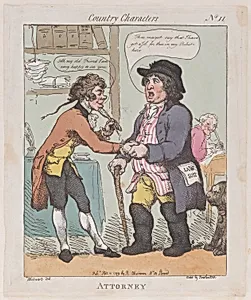
Medium
Hand-colored etching
Dimensions
Sheet (trimmed): 9 3/4 × 8 1/16 in. (24.7 × 20.5 cm)
Classification
Prints
Department
Drawings and Prints
Museum
Metropolitan Museum of Art, New York, NY
Credit
The Elisha Whittelsey Collection, The Elisha Whittelsey Fund, 1959
Accession Number
59.533.1921
Rights
Public Domain
Tags
Art Historical Context
"Attorney" is a lively hand-colored etching from September 10, 1799, created by British satirist George Murgatroyd Woodward, with coloring and etching contributions from the renowned Thomas Rowlandson and published by Rudolph Ackermann in London. Measuring about 9¾ × 8 inches, this print belongs to the Metropolitan Museum of Art's Elisha Whittelsey Collection. As a classic example of Georgian-era caricature, it exemplifies the booming market for affordable, witty prints that poked fun at society. Rowlandson, a master of exaggerated figures and humorous vignettes, collaborated frequently with Woodward on satirical works, while Ackermann's Repository of Arts popularized such hand-colored etchings for middle-class audiences. The medium's vibrant hand-applied colors brought the satire to life, making it a collector's delight. Titled "Attorney," the piece likely lampoons the legal profession—a favorite target in late 18th-century Britain amid growing public skepticism toward pompous lawyers—with men and dogs adding layers of visual comedy, perhaps equating canine mischief to courtroom antics. This artwork captures the spirit of Regency satire, blending sharp social commentary with playful artistry. It reflects how prints like this democratized humor, influencing public opinion and paving the way for later cartoonists. Visitors will appreciate its cheeky charm and historical snapshot of British wit.
About the Artist
George Murgatroyd Woodward|Thomas Rowlandson|Rudolph Ackermann, London · 1765–1809
**George Murgatroyd Woodward (1765–1809)**, often known as George “Moutard” or “Mustard” Woodward, was an English caricaturist and humor writer whose energetic, sometimes crude drawings captured the social follies of late Georgian Britain. Born at Stanton Hall in Stanton by Dale, Derbyshire, as the son of William Woodward, he grew up in the county before moving to London around 1791–92. Woodward ...