
August (Augustus)
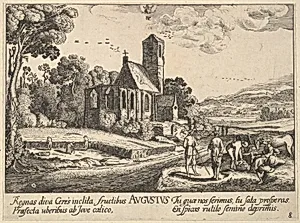
Medium
Etching
Classification
Prints
Department
Drawings and Prints
Museum
Metropolitan Museum of Art, New York, NY
Credit
The Elisha Whittelsey Collection, The Elisha Whittelsey Fund, 1951
Accession Number
51.501.5453
Rights
Public Domain
Tags
Art Historical Context
This etching, titled *August (Augustus)* and dated 1628–29, captures a lively rural scene featuring churches, men, horses, and trees, likely evoking the month of August through its harvest or seasonal imagery. Created through the collaborative efforts of Wenceslaus Hollar and Jan van de Velde II, the work exemplifies the vibrant printmaking traditions of the early seventeenth century in Northern Europe. Hollar, known for his precise topographical views, and van de Velde II, a master of Dutch landscape prints, brought together their skills to produce an image rich in everyday detail. Etching allowed artists to achieve fine lines and atmospheric effects, making it an accessible yet sophisticated medium for disseminating scenes of nature and human activity to a wide audience. This print reflects the period’s growing interest in the natural world and seasonal cycles, themes popular in Dutch and Flemish art during the Golden Age. Now part of the Metropolitan Museum of Art’s Drawings and Prints collection, it offers visitors a glimpse into how 17th-century artists used printmaking to celebrate both the landscape and the rhythms of rural life.
About the Artist
Wenceslaus Hollar|Jan van de Velde II · 1607–1677
Wenceslaus Hollar (1607-1677) was a prolific Bohemian etcher who became one of the most accomplished printmakers of the seventeenth century. Born in Prague, he trained under Matthäus Merian in Frankfurt before entering the service of Thomas Howard, Earl of Arundel, in 1636. Hollar spent most of his career in England, where he produced approximately 2,740 etchings documenting an extraordinary range...