
Auguste Vacquerie
1853–56
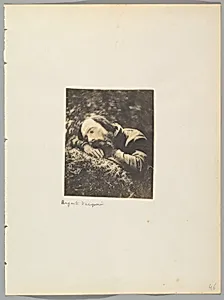
Medium
Salted paper print from paper negative
Dimensions
Image: 9.2 x 7.6 cm (3 5/8 x 3 in.) Mount: 24.8 x 18.4 cm (9 3/4 x 7 1/4 in.)
Classification
Photographs
Department
Photographs
Museum
Metropolitan Museum of Art, New York, NY
Credit
Gilman Collection, Gift of The Howard Gilman Foundation, 2005
Accession Number
2005.100.176
Rights
Public Domain
Tags
Art Historical Context
In the mid-19th century, as photography emerged as a revolutionary medium, Charles Victor Hugo—son of the famed French author Victor Hugo—captured portraits of his family's close circle. This salted paper print from a paper negative, titled *e Vacquerie* (1853–56), depicts poet and dramatist Auguste Vacquerie, a lifelong friend of Victor Hugo. The small image size (9.2 x 7.6 cm) mounted on a larger sheet suggests it was a personal keepsake, highlighting early photography's role in preserving private moments amid the era's literary and artistic ferment. The calotype process used here, involving a paper negative, was a hallmark of 1840s–50s photography, pioneered by William Henry Fox Talbot. It allowed for multiple prints from a single negative, unlike the unique daguerreotypes, fostering photography's artistic potential. Hugo's soft, tonal portrait exemplifies this technique's subtle gradations, lending a painterly quality to Vacquerie's thoughtful gaze. Part of the Metropolitan Museum of Art's Gilman Collection, this work underscores the Hugo family's pioneering embrace of photography during the Second Empire. It bridges Romantic literature and visual innovation, offering visitors a glimpse into the personal lives of cultural icons.