
Augustus
15th century
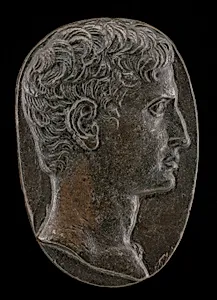
Medium
bronze//Dark brown patina
Dimensions
overall (irregular oval): 4.65 x 3.16 cm (1 13/16 x 1 1/4 in.) gross weight: 33.21 gr (0.073 lb.)
Classification
Sculpture
Department
CSD
Museum
National Gallery of Art, Washington, D.C.
Credit
Samuel H. Kress Collection
Accession Number
1957.14.175
Rights
Public Domain
Art Historical Context
This exquisite small-scale bronze sculpture, titled *Augustus*, hails from 15th-century Florence and pays homage to the ancient Roman who founded the Roman Empire. Crafted "after the Antique," it reflects the Renaissance fascination with classical antiquity, as Florentine artists meticulously studied and replicated Greco-Roman prototypes to revive their idealized forms and heroic ideals. At just 4.65 x 3.16 cm and weighing a mere 33 grams, this intimate plaquette—likely intended for a collector's cabinet or personal study—was cast in bronze with a rich dark brown patina, evoking the timeless allure of ancient artifacts. The work exemplifies the technical prowess of Florentine bronze founders during the Quattrocento, a period when sculptors like Donatello and Ghiberti perfected lost-wax casting to achieve fine details in portraiture and anatomy. By portraying Augustus in a dignified, imperial bust, it bridges pagan Rome with Christian Renaissance humanism, symbolizing power, leadership, and the continuity of Western civilization. Part of the Samuel H. Kress Collection at the National Gallery of Art, this piece invites visitors to ponder how 15th-century innovators transformed antique inspirations into emblems of their own era's cultural rebirth.