
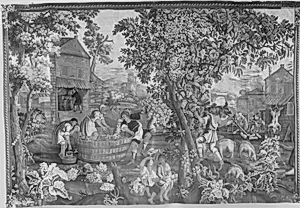
Autumn from a set of The Seasons
early 18th century
Medium
Wool, silk (18-21 warps per inch, 9-10 per cm.)
Dimensions
8 ft. 9 in. × 12 ft. 11 in. (266.7 × 393.7 cm)
Classification
Textiles-Tapestries
Culture
British, London
Department
European Sculpture and Decorative Arts
Museum
Metropolitan Museum of Art, New York, NY
Credit
Bequest of Mary Anna Palmer Draper, 1915
Accession Number
15.43.311
Rights
Public Domain
Tags
Art Historical Context
"Autumn," part of a grand set depicting *The Seasons*, is a magnificent early 18th-century tapestry woven in London, attributed to John Chabanex after designs by the Spanish Baroque master Bartolomé Esteban Murillo. Measuring an impressive 8 feet 9 inches by 12 feet 11, this wool-and-silk masterpiece showcases the opulence of European decorative arts, where such large-scale wall hangings adorned the halls of wealthy estates, symbolizing the cyclical rhythms of nature and human labor. The scene bursts with vibrant harvest imagery: clusters of ripe grapes, men and women gathering crops, playful children, and even pigs rooting nearby, evoking the abundance and communal joy of autumn. Murillo's influence shines through in the lively, genre-like figures—peasant families rendered with warmth and realism—translated into tapestry via a fine weave of 18-21 warps per inch (9-10 per cm), a testament to skilled London weavers who blended silk's luster with wool's durability for enduring color and detail. Bequeathed to the Metropolitan Museum of Art in 1915 by Mary Anna Palmer Draper, this tapestry highlights Britain's role in the 18th-century textile trade, bridging continental painting traditions with practical luxury. Visitors can almost hear the laughter amid the falling leaves, a timeless celebration of seasonal bounty.