
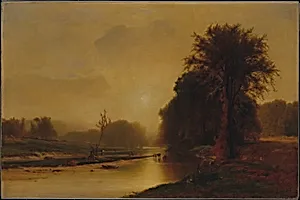
Autumn Meadows
1869
Medium
Oil on canvas
Dimensions
30 x 45 1/2 in. (76.2 x 115.6 cm)
Classification
Painting
Culture
American
Department
The American Wing
Museum
Metropolitan Museum of Art, New York, NY
Credit
Gift of Walter Knight Sturges, 1974
Accession Number
1974.75
Rights
Public Domain
Tags
Art Historical Context
George Inness's *Autumn Meadows* (186), an oil on canvas measuring 30 x 45½ inches, captures the tranquil beauty of the American countryside in late fall. Painted during a pivotal period in Inness's career, this features glowing meadows bisected by winding rivers, evoking a of quiet harmony between earth and sky. As a leading figure in American Tonalism—a movement that emphasized mood and atmosphere over precise detail—Inness drew inspiration from the Hudson River School but infused his works with a mystical, almost spiritual quality, reflecting the post-Civil War yearning for solace in nature. The artist's masterful use of oil allowed for subtle blending of warm ochres, golds, and earthy tones, creating a luminous haze that blurs horizons and invites contemplation. This technique underscores Tonalism's shift toward emotional resonance rather than literal depiction, making *Autumn Meadows* a prime example of how 19th-century American artists celebrated the nation's expanding wilderness amid rapid industrialization. Housed in The Metropolitan Museum of Art's American Wing since its 1974 gift from Walter Knight Sturges, this piece remains a testament to Inness's enduring influence on landscape painting, reminding visitors of autumn's fleeting poetry and the timeless allure of the pastoral American scene.
About the Artist
George Inness · 1825–1894
George Inness (1825–1894) was an American landscape painter regarded as one of the most important figures in nineteenth-century American art, bridging the Hudson River School tradition and a more personal, spiritually-inflected vision of nature. Born near Newburgh, New York, he received limited formal training, studying briefly with Régis François Gignoux, but was largely self-taught, developing h...