
Ax Blade (Celt)
Unknown Artist
1500–500 BCE
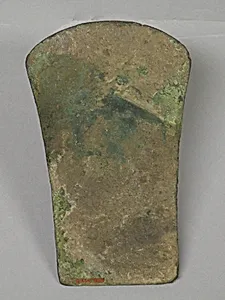
Medium
Copper
Dimensions
4 x 6 1/2 in. (10.2 x 16.5 cm)
Classification
Metalwork
Culture
India
Department
Asian Art
Museum
Metropolitan Museum of Art, New York, NY
Credit
Gift of Anita and Stanley Eisenberg, 1986
Accession Number
1986.497.5
Rights
Public Domain
Tags
Art Historical Context
This copper ax blade, known as a celt, hails from ancient India around 1500–500 BCE, a formative period in the region's Bronze Age. Crafted by an unknown artisan, it measures a practical 4 x 6½ inches (10.2 x 16.5 cm), designed for use as both a tool for chopping wood and possibly a ceremonial or status symbol. Its classification as metalwork highlights early advancements in Indian metallurgy, where copper—sourced from local mines—was hammered and shaped into durable forms, predating widespread bronze alloys. Associated with the Gandhara region (modern-day northwest India and Pakistan), this artifact reflects the cultural and technological exchanges along ancient trade routes. Celts like this one were essential to agrarian societies, aiding in farming, construction, and warfare, while their polished surfaces suggest skilled craftsmanship and value. The Gandhara tag evokes a crossroads of influences, though this piece predates the later Greco-Buddhist art for which the area is famous. A generous gift to the Metropolitan Museum of Art from Anita and Stanley Eisenberg in 1986, this celt offers a tangible glimpse into prehistoric India's ingenuity, bridging the gap between stone tools and more complex metalworking traditions.