
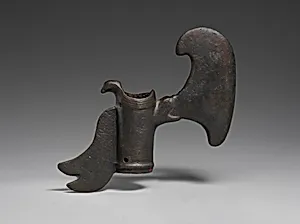
Axe head
Unknown Artist
ca. early 2nd millennium BCE
Medium
Bronze
Dimensions
4.13 x 5 in. (10.49 x 12.7 cm)
Classification
Metalwork-Implements
Culture & Period
Elamite · Old Elamite
Department
Ancient Near Eastern Art
Museum
Metropolitan Museum of Art, New York, NY
Credit
Gift of Farhadi & Anvian Co., 1965
Accession Number
65.145.1
Rights
Public Domain
Art Historical Context
This finely crafted bronze axe head hails from the Old Elamite period in ancient southwestern Iran, around the early 2nd millennium BCE Measuring a compact 4.13 x 5 inches, it exemplifies the metalworking prowess of the Elamites, a civilization contemporaneous with Mesopotamia's early dynasties. As a practical implement, it likely served both as a tool for woodworking or agriculture and a weapon in warfare or hunting, reflecting the dual-role artifacts common in ancient societies. Bronze, an alloy of copper and tin, represented a technological leap during this era, enabling stronger, more durable objects than pure copper or stone predecessors. Elamite artisans mastered lost-wax casting and hammering techniques, producing tools with sharp edges and balanced forms. Though the artist remains unknown, this piece's clean lines and robust construction highlight the Old Elamite style's emphasis on functionality fused with subtle aesthetic refinement. Housed in the Metropolitan Museum of Art's Ancient Near Eastern Art department, this axe head—gifted in 1965—offers a tangible link to Elamite daily life and craftsmanship. It underscores how such implements were not mere utilities but symbols of skill and status in a world of emerging urban centers and trade networks.