
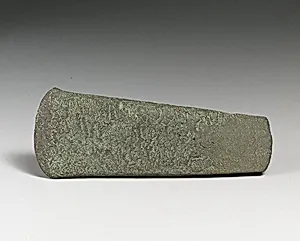
Axehead
Unknown Artist
ca. 3200–2000 BCE
Medium
Bronze
Dimensions
Other: 4 1/8in. (10.5cm)
Classification
Bronzes
Culture & Period
Cypriot · Early Bronze Age
Department
Greek and Roman Art
Museum
Metropolitan Museum of Art, New York, NY
Credit
The Cesnola Collection, Purchased by subscription, 1874–76
Accession Number
74.51.5391
Rights
Public Domain
Art Historical Context
This Cypriot axehead, forged from bronze around 3200–2000 BCE the Early Bronze Age, a glimpse into one of the ancient Mediterranean's earliest metallurgical hubs. Cyprus, rich in copper deposits—the island's name even inspired the Latin word *cuprum*—was a pioneer in bronze production, blending copper with tin to create stronger tools and weapons. Measuring just over 4 inches, this compact artifact exemplifies the practical ingenuity of prehistoric craftsmen who cast or hammered the metal into a functional, double-edged form. As a product of the Cesnola Collection, acquired for the Metropolitan Museum of Art in the 1870s, the axehead highlights Cyprus's pivotal role in Bronze Age trade networks linking the Near East, Aegean, and beyond. While likely used for chopping wood, farming, or combat, such tools also symbolized status and technological prowess in a society transitioning from stone to metal. Its simple yet robust design reflects early experimentation with alloying, paving the way for the sophisticated bronzes of later eras. Today, this unassuming object reminds us how everyday implements drove cultural evolution, connecting ancient Cypriots to the dawn of the Bronze Age revolution.