
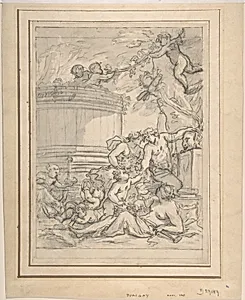
Bacchanal
17th century
Medium
Black chalk, brush and gray wash, incised
Dimensions
11 3/16 x 8 3/16 in. (28.4 x 20.8 cm)
Classification
Drawings
Department
Drawings and Prints
Museum
Metropolitan Museum of Art, New York, NY
Credit
Purchase, Stephen A. Geiger Gift and Harry G. Sperling Fund, 2001
Accession Number
2001.120
Rights
Public Domain
Tags
Art Historical Context
**Bacchanal**, a captivating 17th-century drawing French artist Michel Dorigny (1616–1665) and Italian painter Giulio Carpioni (161–1678), evokes the exuberant spirit of Baroque revelry. Created using black chalk, brush and wash with incised lines, this preparatory sheet measures 11 3/16 x 8 3/16 inches and now resides in the Metropolitan Museum Art's Drawings and Prints, acquired through generous gifts in 2001. Dorigny, known for his elegant figures influenced by Simon Vouet, and Carpioni, a Venetian master of lively genre scenes and mythological frolics, likely collaborated or drew inspiration from shared motifs of Dionysian excess. The composition bursts with dynamic heads of men and female nudes, capturing the chaotic joy of a bacchanal—a classical theme celebrating wine, music, and abandon rooted in ancient Roman festivals honoring Bacchus. The incised lines suggest it was used for tracing onto another surface, a common technique for multiplying designs in workshops. Gray wash adds subtle tonal depth, heightening the sensual energy and movement typical of Baroque draftsmanship. This intimate drawing offers a window into 17th-century artistic practice, blending French refinement with Italian vitality during an era when such mythological scenes symbolized life's pleasures amid Counter-Reformation tensions. A true gem for lovers of old master sketches! (198 words)
About the Artist
Michel Dorigny|Giulio Carpioni · 1616–1665
French painter. Comment on works: Painter; History; Portrait; Engraver; Religious; Mythology; Draughtsman