
Bacchanal
Medium
Engraving
Dimensions
Sheet (Trimmed): 17 11/16 × 21 7/8 in. (45 × 55.6 cm)
Classification
Prints
Department
Drawings and Prints
Museum
Metropolitan Museum of Art, New York, NY
Credit
The Elisha Whittelsey Collection, The Elisha Whittelsey Fund, 1949
Accession Number
49.97.523
Rights
Public Domain
Tags
Art Historical Context
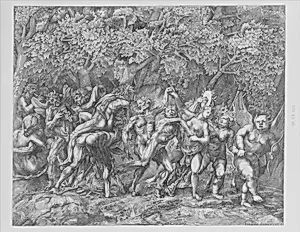
In the vibrant world of 16th-century Venetian art, *Bacchanal* (ca. 1557), an impressive engraving by Giulio Sanuto Domenico Campagnola, the wild ecstasy of classical revelry. Campagnola, a skilled engraver influenced by Titian's dramatic style, collaborated here with Sanuto to produce this large-scale print—measuring nearly 18 by 22 inches on trimmed sheet. Engravings like this were revolutionary for their time, allowing intricate details to be reproduced and widely shared, democratizing access to mythological scenes that celebrated life's pleasures. The composition bursts with chaotic energy: drunken satyrs and mischievous demons carouse amid musical instruments, evoking the frenzied rites of Bacchus, the Roman god of wine. These figures, rooted in ancient Greco-Roman lore revived during the Renaissance, symbolize uninhibited joy, fertility, and the blurring of human and mythical boundaries—a popular theme in Venetian art that reflected humanism's embrace of sensory delight over medieval restraint. Housed in the Metropolitan Museum of Art's Drawings and Prints department as part of The Elisha Whittelsey Collection, this work exemplifies the technical mastery of engraving, where fine lines convey motion and texture. It's a window into Renaissance Venice's cultural fascination with antiquity, inviting visitors to revel in its lively abandon.