
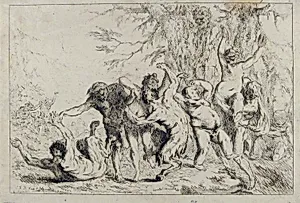
Bacchanal
mid-18th century
Medium
Etching
Dimensions
sheet: 6 3/4 x 9 15/16 in. (17.2 x 25.2 cm)
Classification
Prints
Department
Drawings and Prints
Museum
Metropolitan Museum of Art, New York, NY
Credit
The Elisha Whittelsey Collection, The Elisha Whittelsey Fund, 1957
Accession Number
57.581.28
Rights
Public Domain
Tags
Art Historical Context
Step into the exuberant world of *Bacchanal*, a-18th-century etching French artist Louis Félix de La Rue. This lively print captures the mythical frenzy of a bacchanalian revelry, featuring dancing male and female nudes playful satyrs—creatures from classical mythology symbolizing uninhibited joy and abandon. Rendered on a modest sheet measuring 6 3/4 x 9 15/16 inches, the work pulses with Rococo flair, evoking the era's delight in sensual, decorative themes inspired by ancient Greek and Roman festivities honoring Bacchus, the god of wine. La Rue, a skilled etcher active in Paris, mastered the intaglio technique of etching, biting acid into a metal plate to create intricate lines and rich tonal contrasts. This allowed for fluid, expressive figures that mimic the swirling energy of oil paintings by contemporaries like François Boucher, blending fantasy with eroticism. Etchings like this were popular reproductions, making high-art mythology accessible to collectors and enthusiasts. Housed in the Metropolitan Museum of Art's Drawings and Prints department as part of The Elisha Whittelsey Collection (acquired 1957), *Bacchanal* reflects 18th-century Europe's fascination with classical hedonism amid Enlightenment refinement—a playful escape into eternal revelry that still captivates today.