
Bacchanal
c. 1550
Medium
Engraving in black on two sheets of ivory laid paper, joined through the center
Dimensions
Image: 45.1 × 55.4 cm (17 13/16 × 21 13/16 in.); Plate: 45.5 × 55.8 cm (17 15/16 × 22 in.); Sheets: 46.5 × 57.4 cm (18 5/16 × 22 5/8 in.)
Classification
engraving
Department
Prints and Drawings
Museum
Art Institute of Chicago
Accession Number
220729
Rights
Public Domain
About this artwork
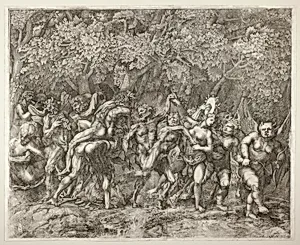
Giulio Sanuto, an idiosyncratic Venetian engraver, reveled in displaying bacchic musical imagery on a large scale. The flutes, panpipes, cymbals, stomping feet, and twisting bodies seen here mark the rowdy procession as quickly degenerating into chaos. The portly and drunken figures with their pendulous quadruple breasts and other anatomical oddities echo the excesses of the paired Bacchanal friezes by Andrea Mantegna (1956.1010 and .1011), while the intertwined poses of the revelers also sugges...
Art Historical Context
**Bacchanal** by Giulio Sanuto, around 1550, captures the exuberant spirit of classical revelry in a grand-scale engraving. This Venetian artist, active in the mid-16th century, in intricate prints that echoed the vibrant mythological scenes of Renaissance masters like Titian. The title evokes a Bacchic festival—wild dances, flowing wine, and ecstatic figures inspired by ancient Roman myths—blending sensuality with classical antiquity, a popular theme during Italy's High Renaissance. Printed in black ink on two sheets of ivory laid paper meticulously joined at the center, the work measures an impressive 45.1 × 55.4 cm for the image alone. This multi-sheet technique allowed engravers like Sanuto to achieve monumental proportions uncommon in prints, making complex compositions accessible beyond paintings. Engraving's fine lines and tonal depth conveyed movement and texture, democratizing art for collectors and scholars. Housed in the Art Institute of Chicago's Prints and Drawings Department, *Bacchanal* exemplifies the technical innovation of 16th-century printmaking, bridging elite patronage with broader cultural appreciation of pagan joys reborn in the Renaissance imagination. A testament to Venice's graphic artistry, it invites viewers to revel in its lively chaos.