
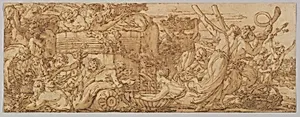
Bacchanal: Arrival at the Wine Vat
ca.1755
Medium
pen and brown ink, brush and brown wash
Dimensions
sheet: 6 5/16 x 16 9/16 in. (16 x 42 cm)
Classification
Drawings
Department
Drawings and Prints
Museum
Metropolitan Museum of Art, New York, NY
Credit
Purchase, Alain and Marie-Christine van den Broek d'Obrenan Gift, 2008
Accession Number
2008.599
Rights
Public Domain
Tags
Art Historical Context
Joseph Marie Vien’s *Bacchanal: Arrival at the Wine Vat* captures a lively procession from classical mythology, rendered in delicate pen and brown ink with fluid brown washes. Created around 1755, the drawing depicts satyrs, putti, and women carrying musical instruments as they converge on a large wine vat, evoking the joyful revelry associated with Bacchus, the Roman god of wine. The horizontal format emphasizes the continuous movement of the figures across the sheet, inviting viewers to follow the celebratory procession. Vien, a leading French artist of the mid-eighteenth century, used this medium to explore dynamic compositions and light effects with remarkable economy. The brown wash creates soft shadows and volume, while the precise ink lines define the energetic poses of the mythological participants. Such drawings often served as preparatory studies for paintings yet stand as independent works of art. Acquired by the Metropolitan Museum in 2008, this sheet reflects the period’s renewed fascination with antique themes and anticipates the neoclassical movement Vien would help pioneer. Its intimate scale encourages close looking, revealing the artist’s skill in translating ancient revelry into an elegant, eighteenth-century vision.
About the Artist
Joseph Marie Vien · 1716–1809
Baroque painter and one of the earliest French painters to work in the Neo-classical style. He influenced some of the most prominent artists of heroic Neo-classicism, including his students Jacques-Louis David, Jean-Baptiste Regnault, Jean-François-Pierre Peyron, and Joseph-Benoît Suvée. Comment on works: History