
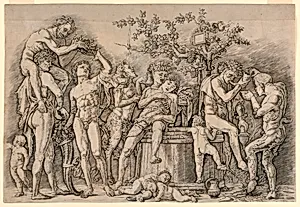
Bacchanal
Medium
figures
Classification
figures
Department
Smithsonian Collection
Museum
Smithsonian American Art Museum
Credit
Bequest of George Campbell Cooper
Accession Number
1896-3-4
Rights
Public Domain
About this artwork
Research in Progress
Art Historical Context
Andrea Mantegna (ca. 1431–1506), a pioneering Italian Renaissance artist from Padua, was renowned for his mastery of perspective, classical antiquity influences, and intricate detail. Active primarily in Mantua for the Gonzaga court, Mantegna bridged Gothic traditions with the emerging Renaissance style, as seen in his frescoes like those in the Camera degli Sposi. Created around 1500 near the end of his career, *Bacchanal* captures the exuberant spirit of mythological revelry, evoking the Roman festivals honoring Bacchus, god of wine and ecstasy—a popular theme in Renaissance art symbolizing earthly pleasures and the Antique revival. Classified as "figures," this work likely represents a sculptural ensemble, possibly in bronze or terracotta, showcasing Mantegna's skill in three-dimensional form alongside his painting prowess. Such small-scale models were prized in Renaissance workshops for study or casting, blending dynamic poses with classical proportions to convey motion and abandon. Its presence in the Smithsonian American Art Museum, via the bequest of George Campbell Cooper, underscores its rarity in American collections and ongoing scholarly interest (research in progress). Visitors will appreciate *Bacchanal*'s lively energy, a testament to Mantegna's innovative fusion of painting techniques with sculptural vitality, inviting reflection on Renaissance humanism's celebration of myth and sensuality.