
Bacchanale
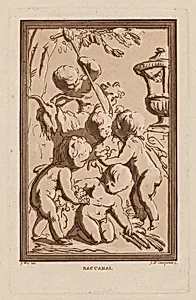
Medium
etching and aquatint with roulette printed in brown on laid paper
Dimensions
plate: 21.5 × 13.5 cm (8 7/16 × 5 5/16 in.) sheet: 28.8 × 20 cm (11 5/16 × 7 7/8 in.)
Classification
Department
CG-E
Museum
National Gallery of Art, Washington, D.C.
Credit
Pepita Milmore Memorial Fund
Accession Number
2018.91.25
Rights
Public Domain
Art Historical Context
This 1766 print captures the lively spirit of a Bacchanale, a classical scene of revelry dedicated to Bacchus, the Roman god of wine. Created by French printmaker François-Philippe Charpentier after a design by Dutch artist Jacob de Wit, the work reflects the enduring 18th-century fascination with mythological subjects drawn from antiquity. De Wit, celebrated for his decorative ceiling paintings and graceful figures inspired by Rubens, provided the original composition, which Charpentier translated into print form for broader appreciation. The medium—an etching and aquatint with roulette printed in warm brown tones on laid paper—highlights the innovative printmaking techniques of the period. Aquatint allowed artists to achieve subtle tonal effects resembling watercolor washes, while the roulette added textured details, bringing depth and movement to the figures. Such reproductive prints played a vital cultural role, enabling wider audiences to enjoy celebrated designs beyond the walls of private collections or grand interiors. Housed in the National Gallery of Art through the Pepita Milmore Memorial Fund, this intimate work (measuring just over 8 by 5 inches in the plate) exemplifies how 18th-century printmakers bridged painting and popular visual culture. Its delicate execution invites viewers to appreciate both the timeless joy of mythological celebration and the artistry of print reproduction.