
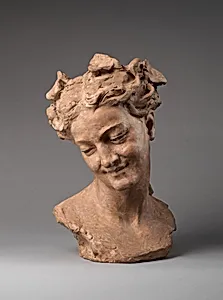
Bacchante with lowered eyes
Medium
Terracotta
Dimensions
Overall (with base): 16 1/2 × 9 × 8 in. (41.9 × 22.9 × 20.3 cm); Height (without base): 14 in. (35.6 cm)
Classification
Sculpture
Culture
French, Paris
Department
European Sculpture and Decorative Arts
Museum
Metropolitan Museum of Art, New York, NY
Credit
Rogers Fund, 1911
Accession Number
11.10
Rights
Public Domain
Tags
Art Historical Context
Jean-Baptiste Carpeaux’s *Bacchante Lowered Eyes* captures a moment of quiet introspection from a follower of Bacchus, the Roman god of wine. Created in 1872 in Paris, the terracotta sculpture reflects the artist’s lifelong interest in mythological subjects infused with emotional depth. Carpeaux, a leading of the Second Empire, often blended classical themes with a lively, almost painterly modeling that brought his figures to life. The medium of terracotta was ideally suited to Carpeaux’s expressive technique, allowing him to work quickly and capture subtle shifts in surface and gesture. Here, the Bacchante’s downcast gaze and gently tilted head from the wild abandon usually associated with these revelers, suggesting instead a private, reflective mood. The compact scale—roughly fourteen inches high—invites close viewing, revealing the artist’s sensitive handling clay and his ability to convey both sensuality and restraint. Acquired by the Metropolitan Museum in 1911, this work exemplifies the vibrant tradition of French sculpture in the late nineteenth century. It offers visitors a glimpse into Carpeaux’s skill at transforming ancient mythology into something intimately human and emotionally resonant.
About the Artist
Jean-Baptiste Carpeaux · 1827–1875
Carpeaux's exuberant work was a decisive break from Neoclassical art. He won the Prix de Rome in 1854 and received many portrait bust commissions from the court. His most famous sculpture group is 'La Danse' (1869) made for the Paris Opéra. So bold is its message of bacchanalian revelry that it was vandalized in protest. French artist.