
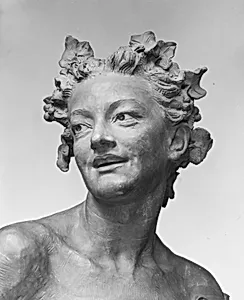
Bacchante with vine leaves
ca. 1872–75
Medium
Terracotta; marble base
Dimensions
Overal (with base): 20 × 15 × 8 in. (50.8 × 38.1 × 20.3 cm); Height (without base): 15 in. (38.1 cm)
Classification
Sculpture
Culture
French
Department
European Sculpture and Decorative Arts
Museum
Metropolitan Museum of Art, New York, NY
Credit
Fletcher Fund, 1925
Accession Number
25.99
Rights
Public Domain
Tags
Art Historical Context
Jean-Baptiste Carpeaux's *Bacchante with Vine Leaves* (ca. 1872–75) captures the wild ecstasy of a follower of Bacchus, the Roman god of wine, adorned with twisting vines and leaves that evoke Dionysian revelry. This intimate terracotta sculpture, standing 15 inches tall on a marble base, showcases a woman's animated face and flowing hair, her expression alive with passion and abandon. Carpeaux, a leading French sculptor of the Second Empire, blended neoclassical precision with romantic vitality, infusing his works with dramatic movement and sensuality. Crafted in terracotta—a versatile, earthy medium favored for its warmth and malleability—this piece likely served as a modello, or study model, for potential marble versions. Carpeaux's technique highlights his mastery of surface texture: the soft modeling of flesh contrasts with the crisp, leafy details, bringing mythological fervor into tangible form. Produced late in his career, it reflects his enduring fascination with exuberant female figures, seen in iconic works like those adorning the Paris Opéra. Housed in the Metropolitan Museum of Art's European Sculpture and Decorative Arts department (acquired via the Fletcher Fund in 1925), this sculpture invites visitors to revel in 19th-century France's fusion of antiquity and modernity, celebrating life's intoxicating joys through art.
About the Artist
Jean-Baptiste Carpeaux · 1827–1875
Carpeaux's exuberant work was a decisive break from Neoclassical art. He won the Prix de Rome in 1854 and received many portrait bust commissions from the court. His most famous sculpture group is 'La Danse' (1869) made for the Paris Opéra. So bold is its message of bacchanalian revelry that it was vandalized in protest. French artist.