
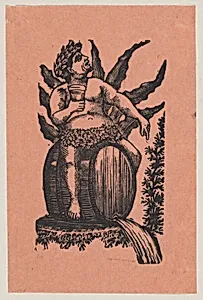
Bacchus astride a wine barrel
ca 1890–1910
Medium
Type-metal engraving
Dimensions
Sheet: 5 1/16 × 3 3/8 in. (12.8 × 8.5 cm)
Classification
Prints
Department
Drawings and Prints
Museum
Metropolitan Museum of Art, New York, NY
Credit
The Elisha Whittelsey Collection, The Elisha Whittelsey Fund, 1946
Accession Number
46.46.419
Rights
Public Domain
Tags
Art Historical Context
Created around 1890–1910, *Bacchus astride a wine barrel* is a lively type-metal engraving by Mexican artists José Guadalupe Posada Manuel Manilla. The print (just over five inches tall) shows the Roman god of wine perched cheerfully atop a barrel, surrounded by drinking glasses—an irreverent twist on classical mythology rendered in the bold, graphic style typical of Mexican popular prints. Posada, who trained under Manilla, became famous for using this accessible medium to reach wide audiences with images that blended European traditions and local humor. Type-metal engraving allowed artists to produce affordable sheets quickly, often sold at markets or used to illustrate broadsides. In the decades before the Mexican Revolution, such prints circulated widely, commenting on social life, politics, and everyday pleasures. Here, Bacchus appears less as a lofty deity than a convivial figure celebrating wine, reflecting the era’s vibrant street culture and the artists’ knack for making grand themes feel familiar and fun. Today the work belongs to the Metropolitan Museum of Art’s collection of prints and drawings, where it offers visitors a glimpse into how Posada and Manilla transformed classical subjects into witty, democratic art that still resonates more than a century later.
About the Artist
José Guadalupe Posada|Manuel Manilla · 1852–1913
José Guadalupe Posada (1852-1913) was a Mexican printmaker and engraver who revolutionized popular art and created some of the most iconic images in Mexican culture. Working primarily with publisher Antonio Vanegas Arroyo, he produced over 20,000 images during his career—inexpensive broadsheets sold for a penny on colored paper that made his art accessible to even the poorest workers. He transform...