
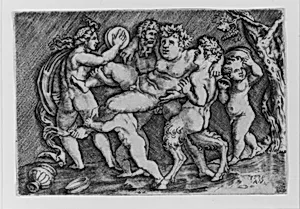
Bacchus Carried by Two Satyrs
Medium
Engraving
Dimensions
2 3/8 x 3 1/2 in. (6.0 x 8.9 cm)
Classification
Prints
Department
Drawings and Prints
Museum
Metropolitan Museum of Art, New York, NY
Credit
The Elisha Whittelsey Collection, The Elisha Whittelsey Fund, 1949
Accession Number
49.97.78
Rights
Public Domain
Tags
Art Historical Context
This small but lively engraving captures the Roman god Bacchus, deity of wine and revelry, being carried by two satyrs—half-human, half-goat companions from classical mythology. Created in 1528 by Agostino Veneziano (also known as Agostino dei Musi), an Italian printmaker active during the High Renaissance, the work reflects the period’s renewed fascination with ancient myths. Artists of the time often turned to Bacchic themes to explore themes of pleasure, nature, and the senses. As an engraving, the medium allowed Veneziano to reproduce intricate details with remarkable precision on a modest scale of just over three inches wide. Such prints played a vital role in spreading Renaissance imagery beyond elite circles, reaching collectors and artists across Europe. The compact format suggests it may have been intended for a personal album or as a study piece. Housed today in the Metropolitan Museum of Art’s Department of Drawings and Prints, the work exemplifies how mythological subjects were reinterpreted through the reproducible art of engraving, bridging classical antiquity with sixteenth-century visual culture.