
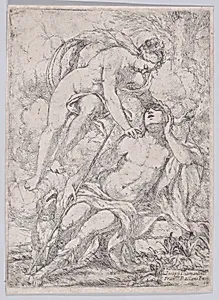
Bacchus, Ceres, and Venus
1650–1700
Medium
Etching
Dimensions
Plate: 10 3/16 × 6 7/8 in. (25.9 × 17.5 cm) Sheet: 10 3/8 × 7 1/8 in. (26.3 × 18.1 cm)
Classification
Prints
Department
Drawings and Prints
Museum
Metropolitan Museum of Art, New York, NY
Credit
The Elisha Whittelsey Collection, The Elisha Whittelsey Fund, 1956
Accession Number
56.595.3
Rights
Public Domain
Art Historical Context
In the enchanting etching *Bacchus, Ceres, and Venus*, Venetian artist Giuseppe Diamantini captures a lively mythological gathering of three classical deities: Bacchus, god of wine and revelry; Ceres, goddess of agriculture and harvest; and Venus, embodiment of love and beauty. Created between 1650 and 1700 during the Baroque era's flourish in Italy, this print reflects the period's fascination with opulent, allegorical scenes drawn from antiquity. Diamantini, a skilled painter and printmaker active in Venice, infused his works with dynamic energy and theatrical drama, hallmarks of the Venetian Baroque style influenced by masters like Titian and Veronese. Etching, Diamantini's chosen medium, was revolutionary in the 17th century for its precision and fluidity. By drawing acid-resistant lines into a metal plate, artists like him could achieve intricate textures and expressive shading unattainable in earlier techniques—perfect for evoking the gods' flowing drapery and bountiful attributes. Measuring a modest 10 3/16 × 6 7/8 inches on the plate, this intimate work from The Metropolitan Museum of Art's Elisha Whittelsey Collection invites close contemplation, highlighting printmaking's role in democratizing art for collectors beyond oil paintings. This piece not only showcases Diamantini's technical virtuosity but also celebrates themes of abundance and harmony, resonating with Baroque ideals of sensory delight and divine splendor. A gem for visitors, it bridges ancient myth with 17th-century innovation.
About the Artist
Giuseppe Diamantini · 1621–1705
Comment on works: Religious; Mythology; History