
Bacchus
1551 to 1600
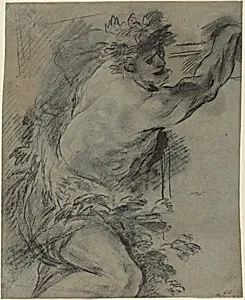
Medium
black chalk with gray wash on blue paper
Dimensions
overall: 35.8 x 29.1 cm (14 1/8 x 11 7/16 in.)
Classification
Drawing
Department
CG-E
Museum
National Gallery of Art, Washington, D.C.
Credit
Gift of Ruth B. Benedict
Accession Number
1994.60.36
Rights
Public Domain
Art Historical Context
This striking drawing of Bacchus, the Roman god of wine, was created by an anonymous Italian artist working in the second half of the sixteenth century, possibly from Naples. Rendered in black chalk with delicate gray wash on blue paper, the work captures the mythological figure in a moment of relaxed revelry, embodying the period’s renewed interest in classical antiquity. Created between 1551 and 1600, the sheet reflects the transitional artistic climate between late Mannerism and the emerging Baroque sensibility, when artists across Italy explored dynamic poses and expressive modeling. The choice of blue paper was especially favored by Italian draftsmen of this era for its rich tonal possibilities. The cool ground allowed the artist to build subtle gradations of light and shadow with chalk and wash, giving the figure a sculptural presence and sense of volume. Such drawings often served as preparatory studies or independent works meant for collectors who valued the spontaneity and skill visible in the handling of materials. Today housed in the National Gallery of Art as a gift of Ruth B. Benedict, this drawing offers visitors an intimate glimpse into the working methods of sixteenth-century Italian artists and the enduring appeal of Bacchus as a symbol of vitality and transformation.