
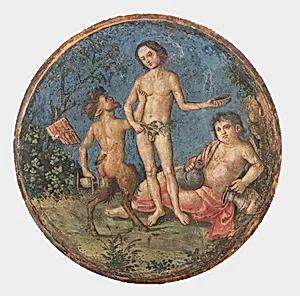
Bacchus, Pan and Silenus
ca. 1509
Medium
Fresco, transferred to canvas and attached to wood panels
Dimensions
Diameter: 19 3/8 in. (49.2 cm)
Classification
Paintings-Decorative
Culture
Italian, Umbria
Department
European Sculpture and Decorative Arts
Museum
Metropolitan Museum of Art, New York, NY
Credit
Rogers Fund, 1914
Accession Number
14.114.19
Rights
Public Domain
Tags
About this artwork
This paintings-decorative titled "Bacchus, Pan and Silenus" by Pinturicchio dates to ca. 1509. Executed in fresco, transferred to canvas and attached to wood panels, this work represents Italian, Umbria artistic traditions. The piece demonstrates the technical skill and artistic vision characteristic of its period. The work's presence in a major museum collection attests to its significance in the broader narrative of art history. As part of institutional holdings, it serves both scholarly resea...
Art Historical Context
In the vibrant world of Renaissance Italy, Pinturicchio's *Bacchus, Pan and Silenus* (ca. 1509) captures the revelry of classical mythology. This circular fresco—originally painted on wet plaster for a wall or ceiling, later transferred to canvas and mounted on wood panels—depicts the wine god Bacchus alongside the goat-legged Pan and the jolly, drunken Silenus, surrounded by lush plants evoking nature's abundance. Measuring just 19 3/8 inches in diameter, its intimate scale suits decorative settings like private chapels or palaces in Umbria, Pinturicchio's homeland. A master of the Umbrian school, Pinturicchio (ca. 1454–1513) blended Perugino's serene lyricism with intricate detail and bright colors, hallmarks of early High Renaissance fresco technique. His works often graced Vatican spaces, showcasing mythological themes that bridged pagan antiquity with Christian humanism, appealing to Renaissance patrons' love of antiquity. Today, housed in the Metropolitan Museum of Art's European Sculpture and Decorative Arts collection (Rogers Fund, 1914), this tondo highlights Umbrian artistic innovation and the era's fascination with Dionysian joy. It invites visitors to ponder how such lively scenes reflected the cultural zest for life, wine, and wilderness in early 16th-century Italy.