
Back View of a Seated Nude Youth Facing Left
1560–1609
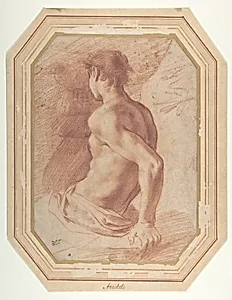
Medium
Red chalk, with traces of highlights in white chalk (?)
Dimensions
Sheet: 12 5/16 x 9 in. (31.4 x 22.8 cm)
Classification
Drawings
Department
Drawings and Prints
Museum
Metropolitan Museum of Art, New York, NY
Credit
Rogers Fund, 1911
Accession Number
11.66.6
Rights
Public Domain
Tags
Art Historical Context
Annibale Carracci (1560–1609) ranks among the most influential artists of the early Baroque period, celebrated for reviving naturalism and classical ideals in Italian art. Created during his lifetime, this red-chalk study of a seated male nude seen from behind reflects the era’s renewed emphasis on direct observation of the human body. Such drawings formed a vital part of artistic training and preparation, allowing painters to explore anatomy, posture, and the play of light musculature before committing ideas to canvas or fresco. The choice of red chalk, occasionally heightened with white, was especially favored in the sixteenth and seventeenth centuries for its warm tonal range and ability to suggest living flesh. Here, Carracci uses delicate hatching and subtle gradations to model the youth’s back, shoulders, and spine with both precision and sensitivity. Measuring just over twelve by nine inches, the sheet demonstrates how even a modest study could convey sculptural volume and quiet monumentality. Preserved today at the Metropolitan Museum of Art, the drawing belongs to the museum’s distinguished collection of works on paper. It offers visitors an intimate glimpse into the working methods of one of Bologna’s greatest masters and underscores the enduring importance of life drawing in Western art.
About the Artist
Annibale Carracci · 1560–1609
Annibale was considered one of the greatest Italian painters of his age. His style is marked by naturalism combined with the formal language of Classicism in a grand and monumental style. Annibale was also instrumental in evolving the ideal, classical landscape and is generally credited with the invention of caricature. Italian painter. Comment on works: Mythology.