
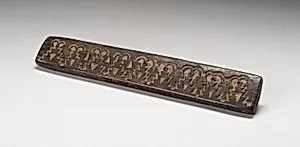
Balance-Beam Scale Insided with Bird, Fish and Geometric Motifs
1000–1470
Medium
Wood
Dimensions
32.2 × 3.8 cm (9 1/8 × 1 1/2 in.)
Classification
wood
Department
Arts of the Americas
Museum
Art Institute of Chicago
Accession Number
126286
Rights
Public Domain
Art Historical Context
This delicate wooden balance-beam scale, crafted by the artist Ica between 1000 and 1470, exemplifies the refined woodworking traditions of pre-Columbian cultures in Americas. Measuring just 32.2 × 3.8 cm, its slender form was designed for precise weighing, likely used in trade, markets, ritual exchanges. The surface is incised with intricate motifs of birds, fish, and patterns, transforming a utilitarian object into a work of art that reflects the maker's skill in carving fine details into hardwood. Housed in the Art Institute of Chicago's Department of Arts of the Americas, this piece hails from a vibrant era of indigenous innovation, possibly linked to the Ica culture of Peru's southern coast. During this period (1000–1470), Andean artisans mastered wood as a medium, often adorning everyday tools with symbolic imagery. Birds and fish motifs may evoke natural abundance or spiritual guardians, while geometric designs add rhythmic harmony, showcasing a blend of functionality and aesthetic philosophy. As a survivor of centuries, this scale invites us to ponder the daily lives of ancient peoples—merchants balancing goods under the sun, their tools etched with stories of the sea and sky. A testament to cultural ingenuity, it bridges the practical and the profound in pre-Columbian artistry.