
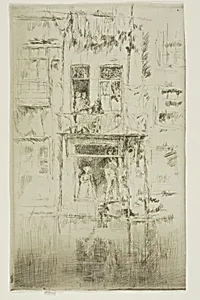
Balcony, Amsterdam
Medium
Etching and drypoint in black ink on ivory laid paper
Dimensions
Image, trimmed within platemark: 27.1 × 16.2 cm (10 11/16 × 6 7/16 in.); Sheet: 27.4 × 16.2 cm (10 13/16 × 6 7/16 in.)
Classification
etching
Department
Prints and Drawings
Museum
Art Institute of Chicago
Accession Number
19809
Rights
Public Domain
Art Historical Context
Step onto the charming streets of 19th-century Amsterdam with James McNeill Whistler'sBalcony, Amsterdam* (1889), a etching and drypoint from Art Institute of Chicago's and Drawings collection. Whistler, the American-born artist who made his home in London, was a of Aestheticism, championing "art for art's sake" through his emphasis on tonal harmony and subtle beauty. Created during a trip to the Netherlands, this intimate scene captures the quiet elegance of a wrought-iron balcony overlooking a canal-side vista, evoking the city's historic Golden Age architecture amid everyday life. Whistler's technique shines here: etching creates crisp, incised lines on a metal plate, bitten by acid for precision, while drypoint adds a soft, velvety burr from direct needle scratches, lending rich texture and depth to the black ink on creamy ivory laid paper. Trimmed close to the platemark at 27.1 × 16.2 cm, the print's intimate scale draws viewers into its atmospheric play of light and shadow, a hallmark of Whistler's innovative printmaking that rivaled his famous oil paintings like the *Nocturnes*. This work exemplifies Whistler's enduring influence on modern printmaking, bridging 19th-century realism with impressionistic subtlety. A gem for print enthusiasts, it invites us to savor the fleeting poetry of urban moments preserved in ink.
About the Artist
James McNeill Whistler · 1834–1903
James Abbott McNeill Whistler (1834-1903) was an American-born painter and printmaker who became a leading figure in the Aesthetic Movement and pioneer of Tonalism and Japonisme. He revolutionized art by championing "art for art's sake" and treating paintings as visual equivalents of musical compositions, titling works as "arrangements," "harmonies," and "nocturnes" to emphasize formal qualities o...