
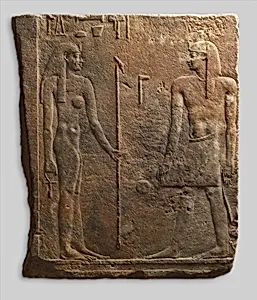
Ball-Playing Ceremony: the king before a goddess, possibly Hathor
Unknown Artist
380–246 B.C.
Medium
Quartzite
Dimensions
H. 85 × W. 71 × D. 7.2 cm, 104.3 kg (33 7/16 × 27 15/16 × 2 13/16 in., 230 lb.)
Classification
Relief, ball-playing ceremony before a goddess, maybe Hathor
Period
Late Period–Ptolemaic Period
Department
Egyptian Art
Museum
Metropolitan Museum of Art, New York, NY
Credit
Purchase, Joseph Pulitzer Bequest, 1947
Accession Number
47.34
Rights
Public Domain
Tags
Art Historical Context
This striking quartzite relief, titled *Ball-Playing Ceremony: the king a goddess, possibly Hath*, dates to Egypt's Late Period or Ptolemaic era (380–246 B.C.), Dynasty 30 or later. Carved from a massive slab (85 × 71 × 7.2 cm, weighing over 230 pounds), it captures a ritual scene where a king stands in reverence before a divine female figure, likely Hathor, the goddess of love, music, and joy. Surrounding hieroglyphs provide inscriptions that would have invoked protection and divine favor, underscoring the artwork's role in royal propaganda and religious devotion. The "ball-playing" ceremony depicted is a rare glimpse into ancient Egyptian festivals, where symbolic games honored fertility and cosmic order. Such rituals blended kingship with mythology, affirming the pharaoh's semi-divine status amid political turmoil—Dynasty 30 marked Persian rule's end, transitioning to Ptolemaic Greek dominance. Quartzite, a durable yet challenging stone prized for its fine grain, highlights the sculptors' mastery of low-relief techniques, achieving depth and vitality on a near-monumental scale. Now at the Metropolitan Museum of Art (purchase, Joseph Pulitzer Bequest, 1947), this piece invites us to ponder how art bridged earthly rulers and eternal gods, preserving Egypt's spiritual traditions through centuries of change.