
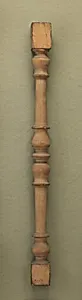
Baluster
Unknown Artist
first half 18th century
Medium
Deal
Dimensions
Height: 24 3/8 in. (61.9 cm)
Classification
Woodwork
Culture
British
Department
European Sculpture and Decorative Arts
Museum
Metropolitan Museum of Art, New York, NY
Credit
Rogers Fund, 1932
Accession Number
32.106.12
Rights
Public Domain
Art Historical Context
Step into the refined world of 18th-century British interiors with this *Baluster*, a masterful example of vernacular woodwork from the first half of the century.ed from deal—a softwood like pine or fir prized for its workability and affordability—this turned column stands at 24 3/8 inches tall. Balusters like this one formed the rhythmic supports for staircases, balconies, or railings in Georgian homes, blending functionality with subtle ornamentation. Though the artist remains unknown, the piece exemplifies the skilled lathe-turning techniques of British craftsmen during the early Georgian period (1714–1760). Deal's smooth grain allowed for precise shaping into graceful, vase-like forms, often seen in middle-class townhouses or country estates. This reflects the era's growing emphasis on domestic comfort and neoclassical symmetry, influenced by Palladian architecture. Acquired through the Rogers Fund in 1932 and housed in The Metropolitan Museum of Art's Department of European Sculpture and Decorative Arts, this baluster offers a tangible glimpse into everyday British life. It highlights how even humble materials could elevate architecture, preserving the artistry of anonymous makers who shaped the nation's built environment.