
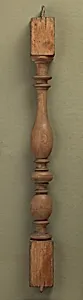
Baluster
Unknown Artist
first half 18th century
Medium
Deal
Dimensions
Height: 25 3/8 in. (64.5 cm)
Classification
Woodwork
Culture
British
Department
European Sculpture and Decorative Arts
Museum
Metropolitan Museum of Art, New York, NY
Credit
Rogers Fund, 1932
Accession Number
32.106.23
Rights
Public Domain
Art Historical Context
This elegant baluster, crafted in the first half of the 18th by an unknown British artisan, exemplifies the refined woodwork of Georgian-era England. Standing at 25 3/8 inches (64.5 cm) tall, it would have formed part of a staircase balustrade or similar architectural feature in a grand home, providing both structural support and decorative flair. Such elements were hallmarks of the period's growing emphasis on symmetry, proportion, and classical inspiration in domestic interiors. Made from deal—a softwood like pine or fir prized for its workability and affordability—this piece highlights masterful turning techniques. Artisans used lathes to shape the wood into graceful, rhythmic forms, often swelling at the center and tapering elegantly at top and bottom. Deal's smooth grain allowed for precise detailing, making it ideal for mass-producing ornamental components that elevated everyday architecture into art. Acquired through the Rogers Fund in 1932 and housed in The Metropolitan Museum of Art's Department of European Sculpture and Decorative Arts, this baluster offers a tangible glimpse into 18th-century British craftsmanship. It reminds us how humble materials, transformed by skilled hands, contributed to the opulent style of the Georgian age.