
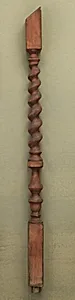
Baluster
Unknown Artist
first half 18th century
Medium
Deal
Dimensions
Height: 31 3/4 in. (80.6 cm)
Classification
Woodwork
Culture
British
Department
European Sculpture and Decorative Arts
Museum
Metropolitan Museum of Art, New York, NY
Credit
Rogers Fund, 1932
Accession Number
32.106.43
Rights
Public Domain
Art Historical Context
This finely turned baluster, crafted from deal—a softwood like pine popular in Britain for its workability—exemplifies the exquisite woodwork of the early 18th century, during the early Georgian period (circa 1700–1750). Standing at 31 3/4 inches tall, it would have formed part of a grand staircase balustrade in a fashionable British home, supporting a handrail while adding rhythmic elegance to interiors inspired by classical Palladian architecture. Though by an unknown artisan, such pieces highlight the skill of provincial woodturners, who used lathes to create smooth, symmetrical forms that balanced functionality with subtle ornamentation. In British decorative arts, balusters like this were status symbols, reflecting the growing prosperity of the merchant class and the influence of architectural pattern books by designers like William Kent. Deal's affordability made it ideal for intricate turning techniques, allowing for twisted or vase-shaped profiles that evoked ancient Roman columns. Acquired through the Rogers Fund in 1932, this baluster now graces the Metropolitan Museum of Art's European Sculpture and Decorative Arts collection, offering a tangible glimpse into everyday luxury of the era. (178 words)