
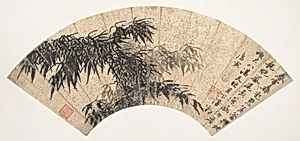
明 唐寅 春雷墨竹圖 摺扇|Bamboo in a spring thunderstorm
17th century
Medium
Folding fan mounted as an album leaf; ink on gold-flecked paper
Dimensions
6 13/16 x 19 5/8 in. (17.3 x 49.8 cm)
Classification
Paintings
Culture & Period
China · Ming (1368–1644) or Qing dynasty (1644–1911)
Department
Asian Art
Museum
Metropolitan Museum of Art, New York, NY
Credit
Edward Elliott Family Collection, Douglas Dillon Gift, 1988
Accession Number
1988.394.1
Rights
Public Domain
Tags
Art Historical Context
This elegant folding fan painting, attributed to the renowned Ming master Tang Yin (1470–1524) and dated to the 17th century, captures bamboo swaying amid the first stirrings of a spring thunderstorm. Rendered in fluid ink washes on gold-flecked paper, the composition transforms a utilitarian fan into a refined work of art. Tang Yin, celebrated for his literati style that blended scholarly restraint with expressive brushwork, often explored natural subjects to convey inner resilience and harmony with nature. Bamboo held deep cultural resonance in Chinese art as a symbol of integrity, flexibility, and perseverance through adversity—qualities evoked here by the dynamic, wind-swept stalks. The intimate scale of the fan format (just under 20 inches wide) suggests it was created for personal enjoyment, perhaps carried during a scholar’s stroll or displayed in a studio. Now mounted as an album leaf, it preserves both the tactile charm of its original purpose and the atmospheric drama of its theme. Acquired by the Metropolitan Museum through the Edward Elliott Family Collection and Douglas Dillon Gift, this piece exemplifies the enduring appeal of Chinese ink painting across dynastic transitions from the Ming into the Qing era.
About the Artist
Tang Yin · 1470–1524
Talented painter whose career as an official painter was ruined by an examination scandal in 1499. Around 1500 he began to study painting with Zhou chen. He was ultimately considered one of the Four Masters of the Ming, along with Shen Zhou, Wen Zhengming and Qiu Ying.